

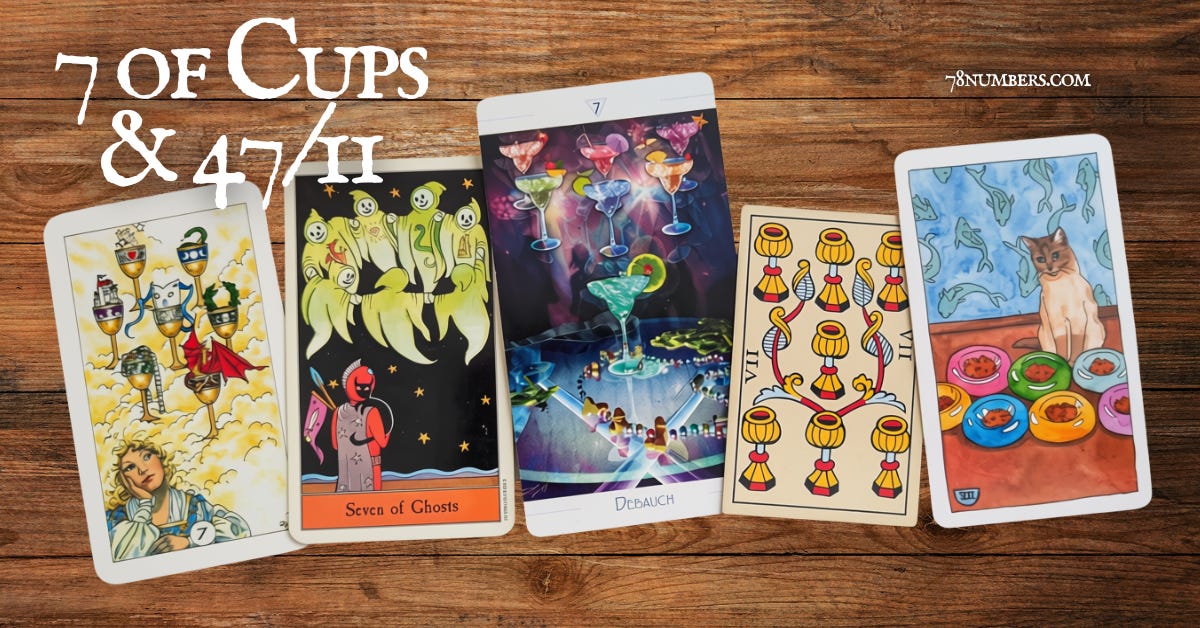
There are some Tarot cards that suffer terribly from keywords, and the Seven of Cups is one of them. If you pick up enough modern Tarot books, you will eventually meet the usual collection:
confusion, fantasy, illusion, too many choices, daydreaming, wishful thinking.
None of those meanings is necessarily wrong.
The problem is that they describe what the card can look like without telling us very much about why it behaves that way. This is one of the reasons I work with compound numbers. In the numerical sequence I use with Tarot, the Seven of Cups is 47/11.
47/11 tells a much more interesting story.
Don’t throw away the 47
Modern numerology has a habit of reducing numbers very quickly.
Forty-seven becomes:
4 + 7 = 11
and, depending on the system, 11 may then become 2.
By the time we are finished, the 47 that got us there has vanished without a trace. If we apply the basic keywords of the 2 vibration, the 7 of Cups would make absolutely no sense at all.
The single-digit root matters, but so does that two-digit compound.
A 47/11 is not interchangeable with every other 11 or even every other 2, because the 4 and the 7 tell us how we arrived at 11.
In my planetary framework:
4 belongs to Rahu/North Node.
7 belongs to Ketu/South Node.
11 belongs to Pluto.
That immediately changes the energy of this particular number and the card that represents it.
Rahu and Ketu in the same number
Rahu and Ketu are the two ends of the lunar nodal axis of astrology. They are opposing polarities that behave very differently.
Rahu reaches. It wants experience. The North Node amplifies appetite, fascination, hunger, possibility, attraction and the feeling that something out there might contain what we are looking for.
Ketu does almost the opposite. The South Node separates. It withdraws. It cuts away. It can detach from something almost as quickly as Rahu becomes fascinated by it.
When we put those two forces together, you get something far more complicated than indecision. You get simultaneous attraction and disconnection:
Something catches our eye. Then something in us backs away from it. Another possibility appears. That one becomes absolutely fascinating. Then its limitations become visible, and another possibility replaces it. The mind, imagination, and desires can move rapidly from one vessel to another because the mechanism contains both hunger and detachment.
Now let’s put that inside the suit of Cups.
When the 7 of Cups presents itself in a reading, we are not simply sorting through practical options on a spreadsheet. Cups bring the process into the territory of emotions; of longing, attachment, imagination, projection, and desire.
Suddenly the Seven of Cups begins to make considerably more sense.
Maybe the problem isn’t too many choices
“Too many choices” is one possible manifestation, but sometimes there aren’t actually too many choices at all. There may be two. There may only be one option. What makes the situation feel confusing is that our relationship to the possibilities keeps changing.
Rahu says: “That. I want that.”
Ketu says: “No. Not that after all.”
Rahu spots another possibility. Ketu finds the hole in it.
And around we go.
This can produce fantasy, certainly. Rahu is very good at enlarging what attracts us. This can also produce disillusionment, because Ketu is very good at showing us what doesn’t satisfy. That creates the peculiar emotional instability of the Seven of Cups. It isn’t simply that the seeker cannot choose. Sometimes the seeker cannot determine which desire is trustworthy or safe.
That is a very different read on things.
Then we arrive at 11
Forty-seven reduces to 11. I do not reduce multiples of 11 further when I work with numbers. It remains 11. I like to keep master numbers unreduced unless a charting method requires single digits, like Ank Jyotish.
Eleven is ruled by Pluto. This emphasizes the upheaval and pressure found within the 11 vibration. Pluto doesn’t generally leave things on the surface. It intensifies, exposes and draws attention toward what is hidden underneath an apparently ordinary problem. The 11 vibration can also be thought of as two 1s. The 1 vibration is ruled by the Sun. Within Master 11 is drama, independence, upheaval, and extreme transformation. Each emanation of 11 contains this energy, but they all go about producing it in different ways. So 38/11 is not the same as 56/11, which is not the same as 47/11, and so on.
But back to 47/11 and the Seven of Cups. This card may appear to be asking:
Which option should I choose?
But 47/11 may be asking something more uncomfortable:
What is doing the choosing?
Is this genuine desire?
Fear?
Projection?
Old hunger?
Avoidance?
The fantasy of becoming somebody different if we obtain the right person, opportunity, identity, spiritual practice, job or future?
Now the card is no longer merely about being overwhelmed by seven shiny cups. Instead, it becomes a card about the psychology of desire itself.
This is why I prefer pip decks
This is especially important when working with the Tarot de Marseille. There is no scenic illustration giving us a person staring at cups filled with tempting visions. We have to read the card in other ways.
For those who think that it’s just seven cups printed on cardstock that don’t mean anything, they need to rethink that assumption. Now, the TdM does not refer to one specific deck, but to a category of decks created in one recognizable style. It was a term coined by antiquarian booksellers in the late 1800s because even back then there were a lot of Tarot decks being created, and they needed a way to communicate to people what styles they had in stock. So each deck within the category of TdM has some differences.
In the deck I use for client readings, the Noblet Marseille, featured in the image above, there are two rows, top and bottom, of three cups each on the card. A seventh cup is in the middle. Two vines emerge from the middle cup of the bottom row. Their lower leaves touch the cups on either side of the central cup. The vines flow upward to the top row, the leaves resting on either side of the central cup on the top row. It appears that the seventh cup is being somewhat contained and separated by the vines, and yet it is not completely cut off from the top row because the vines envelope both it and the base of the central cup in the top row.
All of the cups are half full. When you work with a deck from the TdM, you need to pay attention to the little things. Medieval and Renaissance card makers couldn’t just put the goodies out on public display. Even in our modern age, divination is illegal in many parts of the world, including the West.
At this point in the Cups sequence, energy has been spent. In fact, they become half full at the point of the Five and stay that way for the rest of the suit, but Ace through Four are full. Ace through Four also have lighter liquid with diagonal lines. Lines going up to the left show concern with the material. Lines going up to the right show concern with the spiritual. The liquid is dark and murky now, though, and half full. Disruption has occurred at the point of the Five, and the management of said disruption, along with what it brings, continues throughout the rest of the suit. Your TdM may show a slightly different progression. I’ll be examining the whole suit in greater detail using the CBD, which is the deck I teach with, when I start releasing video lessons.
Depending on your point of view, the seventh cup is a thing being considered, an option or result being integrated, or even something being rejected.
The number gives us a mechanism. It tells us what stage of the game we’re at, and this is quite helpful. At the point of the 7 vibration, disruption has already occured (the 5 vibration) followed by a restoration of order (the 6 vibration). Now, we are stepping off the train and sequestering ourselves for a period of time to consider our options. True space to breathe came at the point of the 6 vibration, and now our imaginations run wild, wanting to know or experience all of the things, and this is expressed across the four Sevens.
The Cups tell us where that mechanism is operating. In this card, the environment is the element of Water. In my system of classifying the cards, the Cups operate within the realm of Cancer. This is a cardinal sign of initiation and leadership, protection, and proactive care. The Moon governs Cancer, controlling inner tides, deep intuition, dreams, and shifting moods. Cancer brings home, family, and sanctuary themes into the emotional landscape of the Cups.
The compound tells us much more than the reduced value alone. With 47/11, 4/Rahu and 7/Ketu create a push-pull between attraction and separation, while Pluto questions what lies beneath the entire cycle. While that can certainly feel like confusion, that confusion itself is the symptom. The deeper question is:
Why does one possibility become irresistible and then suddenly lose its power?
The Seven of Cups at its best
There is a healthy side to this card. Too often, we focus on one thing in certain cards, flattening them into a one-dimensional interpretation.
The ability to imagine multiple realities, alternatives, endings, universes, choices, etc is not a defect.
Neither is the ability to recognize that something we wanted does not actually suit us. Rahu opens us up to the myriad of possibilities, Ketu seeks answers, reaches through the fog or din of everyday existence, and discriminates, while Pluto strips away what is false and makes us question everything we thought we knew to be true.
Used well, the energy encapsulated within the 47/11 vibration that is symbolized visually by the Seven of Cups can become a powerful process of refinement or — and I cringe a bit to use this word, but my vocabulary is limited with only one cup of coffee in me — manifestation.
We explore, imagine, and notice what attracts us. Then we begin the process of integration and discover what doesn’t hold up. Eventually we begin to understand the difference between wanting an image and wanting the thing itself. That is considerably more useful than simply being told, “Oh, you’re confused/trying to escape reality/daydreaming.”
The number beneath the keyword
This is one of the reasons I resist flattening Tarot cards into a handful of memorized meanings and keywords.
“Confusion” can be useful shorthand, but shorthand is not interpretation.
When I see the Seven of Cups as 47/11, I see desire as it encounters detachment, possibility as it encounters discernment, and ultimately the Plutonian demand to discover what actually drives the yearning. Sometimes this card is asking us to choose; sometimes it is asking us to step back and wait on the fringes of a situation until the fog clears on its own — and sometimes it is asking us to do the uncomfortable work of integrating one or more new realizations so that we can experience which one works.