

(Yes, it’s now out of season, but bear with me as I move some posts over from Patreon….I can’t backdate them here on Substack)
The Four Great Family Barbecues
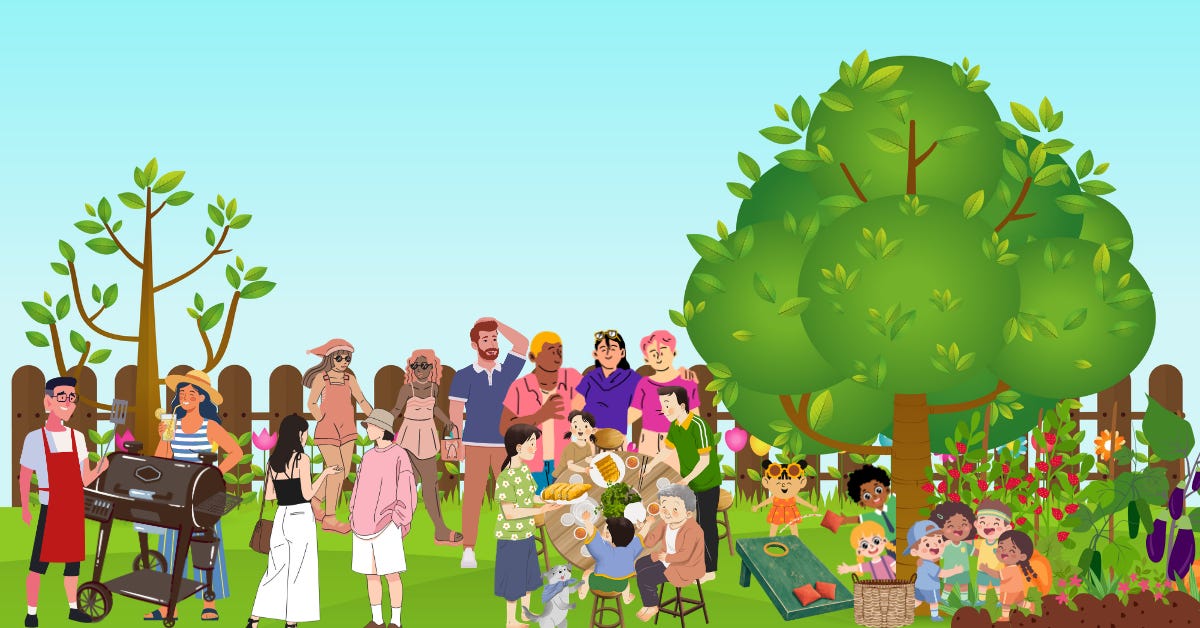
Summer has arrived in Tarot Town, which means the grills are out, the folding chairs have been dragged up from the basement, and every family in town is arguing about who makes the best potato salad.
The four oldest families of Tarot Town: the Wands, Cups, Swords, and Pentacles, each host a barbecue during the summer. On the surface, these gatherings appear to have much in common. There is grilled meat, an assortment of salads, a cooler full of drinks, and at least one person complaining about the mosquitoes.
Look a little closer, however, and you’ll see that each family approaches the sacred tradition of the family summer cookout in an entirely different way:
The Wands turn it into a festival.
The Cups make it a family reunion.
The Swords organize it with military precision and then argue about everything.
The Pentacles quietly feed half the county.
A gathering like this also gives us a chance to see how the numbered cards develop. In every family, the Ace shows a beginning with possibilities. The Two gives this energy a direction. The Threes of the suits make a plan. By the Four, the barbecue has become real, and then the Five arrives to make sure nothing goes exactly as intended.
After that, the family adapts, experiments, reorganizes, and eventually reaches the Ten: the moment when the entire experience has developed as far as it can, and everyone must decide what happens next.
So grab a paper plate and something cold to drink. We’re going people-watching again.
The Wands Family Barbecue
Loud, ambitious, competitive, and very much on fire
Nobody receives a formal invitation to the Wands barbecue.
You hear about it from someone who knows someone. Then a cousin adds you to a group chat called WANDS FAMILY BBQ—LET’S GOOOOOO, which immediately generates 147 notifications.
On the day of the event:
The King of Wands is at the grill, naturally. He has purchased a smoker large enough to require its own parking space and has been explaining the science of brisket to anyone who foolishly makes eye contact.
The Queen is directing traffic, greeting guests, finding extension cords, and somehow organizing at least five other activities simultaneously.
The Knight has been sent into town for ice. He returns with fireworks, water balloons, two cases of energy drinks, and, of course, absolutely no ice.
The Page is running around the yard livestreaming everything on TikTok.
Ace of Wands: The Big Idea
The barbecue begins when one member of the family says:
“We should have people over this weekend.”
It is an innocent suggestion. A small spark. Within minutes, the idea has grown into a barbecue, bonfire, neighbourhood block party, cornhole tournament, talent show, and fireworks display.
Nobody has checked whether any of this requires permits or town permission. The Ace does not concern itself with practical details. It simply creates the desire to begin. The possibility is alive now, and the Wands family is already running with it.
Two of Wands: How Big Are We Making This?
Someone has to choose what kind of gathering this will be:
Immediate family only?
The entire extended family?
The whole street?
Why stop there? Let’s just put out an open invitation. The King of Wands knows a band.
The Two of Wands finds the family standing in the backyard, looking over the available space and imagining what could happen there. The original idea is being measured against its possibilities.
A decision is made, and they are going to go big.
Naturally.
Three of Wands: The Planning Committee
The Queen of Wands creates several committees, and although no one remembers volunteering for any of them, they find themselves being volun-told.
One cousin handles food. Another manages music. Someone is assigned to activities. The Page designs an online invitation featuring animated flames. They’ve used Canva to turn an image of the King’s smoker into a dumpster fire for the Facebook group banner. Everyone thinks it’s hilarious.
There is now a plan, although the plan changes every twenty minutes as new ideas arrive.
The Three allows the family to step back and see the larger picture. The spark of the Ace and the direction chosen at the Two are becoming something that could actually work.
They hope.
Four of Wands — The Party Begins
By four o’clock, the yard has been transformed.
There are picnic tables, coolers, lawn games, strings of coloured lights, and a homemade banner hanging between two trees. Music is playing. Food is cooking. Children are running through the sprinkler.
For one shining moment, everything is working.
The barbecue has moved out of the imagination and taken solid form. The family is gathered. The gate is open. Everyone is celebrating.
Even the Mayor stops by and admits that it looks impressive. He does, however, have questions about the electrical wiring and permits. The King lets him sample some of the bark off the brisket. All is well. They’ll meet at the diner on Monday morning for breakfast.
Five of Wands — The Cornhole Incident
It begins as a friendly tournament, and then someone disputes a score.
A cousin insists that his foot did not cross the line. Another accuses him of distracting the opposing team. The Knight of Wands introduces a complicated trick-shot rule that nobody agreed to.
Within minutes, six people are shouting over one another while the Page provides live commentary to their TikTok followers.
Nobody is genuinely angry. Not yet, but every Wands gathering contains a point at which enthusiasm becomes competition and competition becomes chaos.
Behind them, the grill flares up.
This does not improve matters.
Six of Wands — A Champion Is Crowned
Eventually, a winner emerges.
The family cheers as though someone has just returned from war. The champion is presented with a plastic trophy left over from when the King coached Little League ten years ago. It is carried around the yard on the shoulders of two cousins.
The disagreement is forgotten because the Wands family respects victory more than it resents conflict. The momentum of the event has been restored. The gathering finds its rhythm again.
The Sheriff arrives in response to a call about “smoke and shouting,” but after receiving a plate of ribs, he decides everything appears to be under control.
It is not.
Seven of Wands — Defending the Grill
By early evening, every adult male at the barbecue has developed an opinion about the smoker. The King of Wands has spent twelve hours tending the brisket. He will not be taking suggestions. Ever.
One person recommends lowering the temperature. Another thinks the meat should be wrapped. The Town Doctor claims this is not how his father did it. The Local Entrepreneur has watched several YouTube videos and would like everyone to know that he owns a meat thermometer.
The King plants himself in front of the smoker with his tongs crossed over his chest.
This is his fire.
He will defend it.
Eight of Wands — Everything Happens at Once
At sunset, the gathering reaches maximum velocity.
The food comes off the grill. The band starts playing. Someone begins the water-balloon fight. Children streak across the yard. A dog escapes with a sausage. The Fool arrives in his purple camper van with The Star and three people nobody recognizes.
Text messages fly through the family group chat even though everyone is standing within fifty feet of one another. For a while, Tarot Town seems to revolve completely around the Wands family yard.
There is no time to think.
Only enjoyment. Pure, unfettered enjoyment of the moment.
Nine of Wands — Still Standing
By ten o’clock, the host is exhausted.
His shirt is stained. One eyebrow may be slightly singed. He has broken up a few arguments, rescued the Page from the roof of the garage, and prevented the Knight from lighting a Roman candle in the driveway.
He stands beside the smoker with a drink in one hand and barbecue tongs in the other, watching the remaining guests carefully. He has survived the evening, but he is also fully prepared for at least one more thing to go wrong.
Someone asks when the fireworks are starting.
Aaaah… there it is, the fuckening. He saunters across the yard and gets the hose ready.
Ten of Wands — Who Is Cleaning This Up?
The final guests leave sometime after midnight.
The yard is covered with paper plates, empty cans, abandoned lawn games, wet towels, folding chairs, and several items that no one remembers bringing. The Queen brings out the lost-and-found box, which is already half full, and adds to it, smiling.
The original spark has reached its fullest expression. The Wands family wanted an unforgettable party, and they created one. Now they must carry the consequences. As the family surveys the wreckage, someone says:
“We should make this an annual thing.”
Everyone groans, but no one says no.
The Cups Family Barbecue
Tender, nostalgic, beautiful, and emotionally complicated
The Cups invitation arrives in the mail.
It is printed on heavy kraft paper with a homespun font and includes a family photograph from a barbecue held twenty years ago. Several people in the picture are no longer alive, three are no longer speaking, and one has since married the person standing behind the camera.
The Queen of Cups hosts the gathering in a garden filled with flowers and strings of tiny fairy lights.
The King tends the drinks and quietly checks on anyone who appears overwhelmed.
The Knight has made a romantic summer playlist.
The Page is catching fireflies in a jar and asking questions that make all of the adults uncomfortable.
Ace of Cups — An Invitation from the Heart
The barbecue begins because someone misses everyone.
The Queen of Cups has been looking through old photographs. She remembers long summer afternoons when the family gathered around picnic tables, and nobody seemed to be in a hurry to leave. When she knows the invitations have reached their destination, she sends a group message:
“We really should all get together.”
The Ace arrives as an emotional opening. It is the wish to reconnect, welcome, celebrate, and fill the family cup again. Before long, people are replying with heart emojis and promises to attend. Even the cousin who never replies to anything says maybe.
Two of Cups — We’ll Do It Together
Hosting the gathering is too much for one person, so the Queen asks another family member to help.
They sit at the kitchen table and decide what kind of barbecue they want to create. Not something enormous. Not something flashy, but something meaningful, something from the heart.
They agree on the date, divide the responsibilities, and promise not to let the rest of the family turn it into a circus.
The Two of Cups gives the original feeling a partner. The desire to reconnect is no longer private; it has been recognized and reciprocated. The gathering now belongs to both of them.
Three of Cups — Everyone Brings Something
Planning quickly becomes a group effort.
One aunt volunteers to bring pasta salad. A cousin offers dessert. Someone else promises to make lemonade. Three relatives begin a separate chat devoted entirely to recreating Grandmother Cups’s potato salad. The Cups family believes food should carry memories.
By the time the menu is complete, there are seven salads, four desserts, two punches, and no firm commitment from anyone to bring hamburger buns.
The Three brings everyone into the process. The celebration is taking shape through friendship, cooperation, and shared anticipation.
Four of Cups — The One Beneath the Tree
Oh my goodness, the gathering is lovely. The aunts have probably shopped Michaels empty. The tables are nestled in a space near a grove of young trees strung with fairy lights. The drinks are cold. Everyone has arrived dressed slightly better than necessary. Every table has a gingham tablecloth. The centrepieces are lacy mason jars with just a touch of glitter, holding rose-scented tea light candles. The napkins have messages printed on them in a handwritten font, from the classic “Live, Laugh, Love” to “Smile more, worry less” to “Eat, drink, and be cozy”. The teenagers are reading them as they stack them beside the plates, rolling their eyes and laughing.
Almost everyone is enjoying themselves.
One member of the family sits apart from the crowd, beneath the old maple tree, poking at a plate of food and staring toward the driveway. The person they hoped would attend has not come.
Other relatives offer drinks, conversation, and slices of pie, but none of it is what they wanted. Sometimes abundance surrounds us while our attention remains fixed on the presence of absence.
At a Cups barbecue, someone always feels this more deeply than everyone else.
Five of Cups — The Missing Recipe
The potato salad does not taste right.
Everyone agrees on this, although they do try to be tactful. No one wants to hurt anyone’s feelings.
Someone added too much mustard. Someone else insists Grandmother used pickle juice. An aunt is certain there should be chopped eggs. Another remembers that Grandmother hated eggs.
The debate begins playfully but soon touches something tender: it is not really about the salad.
It is about the people who are missing, the traditions that cannot be perfectly recreated, and the painful realization that memory changes each time it is revisited.
For a few minutes, the mood sinks. Then someone notices that three other bowls of salad remain untouched.
Six of Cups — The Old Photographs Come Out
After dinner, the children ask what their parents were like when they were young. This is all the encouragement the older relatives need.
Boxes of photographs appear from out of nowhere. Seriously, where did they just come from? Stories are told. Teenagers learn far more than they wanted to know about their parents’ haircuts, clothing, and romantic histories.
The Town Librarian stops by, and while she visits and enjoys a slice of apple pie, supplies the full story behind a family photograph taken at the lake in 1986.
The Cups gathering settles into a familiar rhythm. The past is not restored exactly as it was, but it is welcomed into the present. Old affection passes between generations, softened by time.
Seven of Cups — Too Many Possibilities
By dusk, the drink table has become rather ambitious.
There are fruit punches, sparkling lemonades, iced teas, sangrias, mocktails, and something blue made by the Knight of Cups that he calls Moonlight on the Water. No one knows what is in it, including the Knight.
The desserts are equally excessive. Guests wander between pies, cakes, trifles, cookies, and frozen treats, unable to decide what they want.
Conversations also drift into possibility.
Someone discusses moving home. Another talks about renewing vows. A cousin has new career ideas and shares them with the table. Two relatives begin planning a family vacation that will probably never happen.
For a while, every dream seems available.
Commitment can wait until morning.
Eight of Cups — Leaving Before Dessert
One person quietly gathers their things.
They have attended these gatherings for years, hoping that an old relationship would become different. Tonight, they finally understand that it will not.
There is no scene in their departure.
They hug the host, decline another drink, and walk down the garden path while the others continue talking beneath the lights.
The Cups family notices emotional departures, even when nobody speaks of them.
The gathering continues, but something has shifted. One family pattern has been closed out.
Nine of Cups — This Is What She Hoped For
Later, the Queen of Cups sits back and looks around the garden. People are laughing. The children are sleepy, curled up in lawn chairs or stretched out on a picnic blanket someone carefully laid out for them. Someone has started singing along with the playlist. The person beneath the tree has long since joined the others.
The evening is not perfect. The recipe was wrong. Someone left early. A few old feelings surfaced. Still, the gathering has become what she hoped it would be: warm, abundant, affectionate, and alive.
She lifts her glass to the crowd, breathes deeply while she smiles, and allows herself to enjoy it.
Ten of Cups — Beneath the String Lights
Before anyone leaves, someone insists on taking a family photograph.
People complain while arranging themselves, but they gather anyway. Children sit in front. Older relatives take the good chairs. Couples stand together, arms around shoulders and waists, beaming and happy as they soak up the energy. Someone calls the absent cousin on video and holds up the phone so they can be included.
For one moment, the family appears whole.
Not flawless. Not free of grief, conflict, or change, but whole and genuine.
The Cups have created a small universe this evening, a safe space for everyone’s shared story. The old memories remain, but new ones have joined them.
Next year, when the invitation arrives, this is the photograph that will be on it.
The Swords Family Barbecue
Efficient, intelligent, opinionated, and not arguing
The Swords invitation arrives by email.
It contains the date, start time, end time, parking instructions, weather contingency plan, dietary questionnaire, and a link to a shared spreadsheet.
Guests are asked to indicate whether they are bringing a side dish, dessert, beverage, or “other.” Anyone selecting “other” must provide further details.
The King of Swords created the schedule. The Queen edited it for clarity. The Knight has already replied-all twice. The Page is fact-checking the invitation.
Ace of Swords — A Better Way to Do This
The barbecue begins with an observation:
“Last year’s gathering was badly organized.”
The speaker does not intend to insult anyone. They are simply stating a fact. A new plan is proposed. This year, the family will eliminate confusion, duplication, food waste, parking problems, and unnecessary delays.
The Ace of Swords cuts directly to the issue. It introduces a clear idea and the possibility of a more rational approach.
Several family members agree, while several others immediately feel criticized.
Two of Swords — The Sauce Stalemate
Before planning can proceed, the family must choose the barbecue sauce.
Half prefer the traditional vinegar-based recipe. The others want the sweeter sauce introduced by an in-law several years ago. Neither side is willing to concede.
A blind taste test is proposed, then rejected because one faction questions the methodology. The Queen of Swords suggests serving both sauces.
No one likes this solution because it avoids determining who is correct. The family reaches an impasse, and for several days, no decision is made.
Three of Swords — The Reply-All Incident
Eventually, someone sends a private message about the sauce dispute. Unfortunately, it is not private. The message goes to the entire family.
Feelings are hurt. Screenshots circulate. One aunt announces that she will not attend if her cooking is considered “an impediment to progress.”
The King of Swords intervenes, reminding everyone that the purpose of the gathering is family unity. The Page replies with a dictionary definition of unity.
This does not help.
Still, the conflict clarifies several things that needed to be said. The planning resumes with fewer illusions and a more accurate understanding of who is angry with whom.
Four of Swords — A Temporary Ceasefire
A rule is established: No further discussion of barbecue sauce until the day of the event.
The group chat goes quiet. Everyone retreats to consider their position, nurse their grievances, and prepare supporting evidence.
For a brief period, peace descends over the Swords family.
It is not a resolution. This is only an intermission.
Five of Swords — Someone Has to Win
The barbecue begins on schedule.
Both sauces are placed on the table, but one relative has printed anonymous scorecards so guests can vote.
What follows is no longer a tasting.
It is a campaign.
Family members lobby undecided guests. Accusations of ballot tampering circulate. Someone moves the sauce bottles to make one more accessible than the other. When the votes are counted, the traditional sauce wins by two.
The victor celebrates.
Everyone else makes a private note never to participate in this nonsense again.
Six of Swords — Moving to Safer Ground
After the sauce vote, the Queen of Swords redirects the conversation.
She asks about travel plans. Someone discusses a new book. Another relative begins telling a story about an unusual bird seen near the river. The family slowly moves away from the conflict.
A few people take their plates to the far end of the yard, where the conversation is calmer. Two cousins leave early and drive home together, analyzing everything that happened.
The barbecue continues.
The waters are not entirely smooth, but at least the family is no longer sinking the boat.
Seven of Swords — The Store-Bought Pie
One guest has claimed for years to make an award-winning blueberry pie.
The Page of Swords becomes suspicious.
The crust is too uniform. The foil plate bears traces of a commercial label. The guest was also seen entering the yard without carrying anything and returning to the car fifteen minutes later.
An investigation begins.
Photographs are enlarged. Receipts are examined. Someone quietly remembers seeing the same pie at the supermarket. By dessert, the truth is undeniable.
The pie is store-bought.
The family does not confront the culprit immediately. They feign ignorance because they would like to see how long the lie continues. They are enjoying this immensely.
Eight of Swords — Trapped by the Rules
The carefully designed system begins to work against everyone.
The person assigned to the grill refuses to cook the vegetarian food because it is not listed in his section of the schedule. Guests cannot move the lawn chairs because the seating chart accounts for shade patterns.
A child is told that the water balloons are scheduled for 4:30. It is currently 4:12.
People begin asking whether they are allowed to eat dessert. The Queen consults the timeline.
What was meant to create clarity has become a cage made of instructions.
Eventually, someone moves a chair without permission. The Knight sneaks the water balloons to the children, and they begin playing on the Slip N Slide ahead of schedule. Nothing terrible happens.
Nine of Swords — The Host Replays Everything
That night, the hosts are still awake reviewing the barbecue:
Should the sauce vote have been eliminated?
Did the vegetarian burgers remain at a safe temperature?
Was the comment about the parking arrangement sarcastic?
Why did Aunt Margaret leave without saying goodbye?
At 2:00 a.m., the King remembers that no one collected the dietary questionnaires.
At 2:17, he slips away to his home office and begins drafting a follow-up email.
At 2:25, the Queen texts him: “Do not send that, come to bed”
Ten of Swords — The End of the Group Chat
The next morning, the Knight of Swords posts a twelve-paragraph assessment of the barbecue.
The Page corrects several factual errors. Someone brings up the pie. The sauce dispute resumes.
Then, without warning, Grandmother Swords leaves the group chat.
Everyone stops typing.
A family institution has fallen.
The gathering has reached its logical conclusion. Every disagreement has been analyzed, sharpened, and carried as far as it can go. The family must now decide whether to continue communicating this way or create something new.
A second group chat appears later that afternoon.
It is called SWORDS FAMILY: NO POLITICS, NO SAUCE.
Grandmother joins.
The Pentacles Family Barbecue
Abundant, traditional, well-supplied, and prepared for weather
The Pentacles barbecue has been held on the family property for as long as anyone can remember.
The trees are mature. The picnic tables were built by hand. The grill has been repaired so many times that only one original part remains.
The King of Pentacles supervises the smoker from a comfortable chair. The Queen has been cooking for three days. The Knight is hauling coolers, tables, and propane tanks.
The Page is in the garden picking tomatoes and being reminded not to eat all the strawberries.
Ace of Pentacles — What We Already Have
The idea begins with the land.
The garden is producing more vegetables than the family can use. The freezer is full. The weather forecast looks good. There is enough room beneath the old maple trees for everyone.
The Queen of Pentacles looks at this abundance and says:
“We should feed people.”
The Ace appears as a practical opportunity. The resources are present. Something tangible can be created from them.
The family does not need to imagine the barbecue.
They already have everything required to begin.
Two of Pentacles — Making the Numbers Work
Feeding the entire family requires calculation.
How many people are coming? How much meat will they need? Can the old refrigerator hold everything? Who will pick up ice? Should they buy another folding table or borrow one from the church hall?
The Pentacles family knows that abundance must be managed.
The Knight makes three trips into town. The Queen shifts trays between refrigerators. The King tries “tweaking” the budget. Everything is juggled until the gathering becomes possible.
Three of Pentacles — Everyone Has a Job
The family operates like a well-trained crew.
One person tends the meat. Another makes bread. Someone washes vegetables. The teenagers set up tables while the younger children carry napkins and cutlery.
Nobody attempts to do everything alone.
Skill is respected here. The cousin who understands smokers handles the smoker. The aunt known for pies makes the pies. The relative who cannot cook is assigned to parking.
The Three of Pentacles brings different forms of competence together. By working collectively, the family creates something none of them could produce alone.
Four of Pentacles — Don’t Use the Good Chairs
The yard is ready.
The coolers are stocked. The tables are covered. The food is protected beneath carefully clipped covers.
The King has also placed several chairs aside and announced that they are reserved. For whom? That part is unclear.
He has locked the shed, hidden the expensive grilling tools, and counted the beverages twice. The Pentacles family values security. They take care of what they own because they worked hard to acquire it.
Sometimes, however, protecting the barbecue begins to look suspiciously like preventing anyone from enjoying it.
The Queen quietly puts the good chairs back so that they can be used.
Five of Pentacles — The Family at the Gate
A recently divorced cousin arrives with two children.
They are late, uncomfortable, and unsure whether they are still welcome. They’ve been out of the loop since the divorce, feeling wounded. They have not brought a dish because money is tight.
For a moment, they stand at the edge of the gathering while everyone else appears busy.
Then the Queen of Pentacles sees them. Within minutes, the children have plates. Someone finds them chairs. A relative slips leftovers into a cooler for them to take home later.
The Five reveals where material security is missing and where someone has been left outside the circle. The family’s abundance means little unless the door is opened.
Six of Pentacles — Take Some Home
The meal is served generously.
The older relatives are helped first. Children receive manageable portions. Someone quietly prepares a plate for the Old Man on the Hill, who refused to attend but will complain if nobody remembers him.
Food circulates in every direction.
Guests bring dishes, receive meals, exchange recipes, and leave with containers of leftovers. The family garden has produced enough to share, and sharing ensures that none of it is wasted.
The balance is not perfectly equal.
It does not need to be.
Today, those who have more give more.
Seven of Pentacles — Waiting on the Brisket
Everything is ready except the brisket.
The King opens the smoker, examines it, and closes the lid.
“How much longer?” someone asks.
“As long as it takes.”
The family has already invested hours of labour. Now they must wait for the result.
People wander through the garden, inspect the fruit trees, and discuss what worked this season. The tomatoes did well. The beans struggled. The new apple tree may produce next year.
The Pentacles understand that worthwhile things develop according to their own timetable.
You cannot rush a brisket. You can, however, eat another devilled egg while you wait.
Eight of Pentacles — The Work Continues
While everyone else relaxes, several family members remain busy.
Corn must be shucked. Plates need replenishing. The grill requires attention. Containers must be labelled. Someone is teaching the Page how to slice tomatoes properly.
The work is repetitive, but it is done with care. This is how the family maintains its traditions: not through grand declarations, but through hundreds of small tasks performed correctly.
The Page watches closely.
Next year, they will know how to do it.
Nine of Pentacles — The Garden Tour
After dinner, the Queen walks through the garden with a glass of iced tea, taking the Old School Marm and Casserole Queen with her.
Together, they admire the herbs, flowers, fruit trees, and neat rows of vegetables. She points out the trellis she built, the berries she planted, and the corner where she plans to add lavender.
She is proud of what she has cultivated. Not because it impresses anyone, although it does.
She is proud because it is hers: the result of knowledge, patience, labour, and the ability to enjoy her own company. For a quiet moment, she sits beneath the grape arbor and surveys everything she has created.
Ten of Pentacles — The Family Table
As evening settles over the property, several generations gather around the long table.
The older relatives tell familiar stories. The children play beneath the trees. Someone asks who will host the barbecue when the King and Queen no longer want to manage it.
The Knight glances toward the Page.
Traditions do not continue automatically. Property must be maintained. Recipes must be taught. Skills, stories, and responsibilities must be handed from one generation to another.
The Pentacles barbecue is larger than one meal. It is part of a family tradition, an inheritance that involves taking care of everyone around them and sharing in their abundance.
Before everyone leaves, the Queen distributes vegetables from the garden and reminds people to return the containers.
They won’t.
She already knows this.
Four Families, Four Ways of Moving Through the Cards
By the end of summer, each family has created the gathering that reflects its deepest nature.
The Wands transformed one spark into a glorious, exhausting spectacle.
The Cups turned a longing for connection into a new family memory.
The Swords attempted to create order through clarity and discovered that even the best system cannot save people from themselves.
The Pentacles used the resources already in their hands to nourish the present and prepare for the future.
In each family, the numbers followed the same developmental rhythm:
The Ace opened the door.
The Two chose a direction.
The Three developed the plan.
The Four gave it solid form.
The Five tested what had been created.
The Six established a workable rhythm.
The Seven expanded the possibilities.
The Eight sorted and organized them.
The Nine brought the suit into mature expression.
The Ten revealed what had been built and asked what would happen next.
That is the secret of the Minor Arcana. The numbers provide the pattern, but the suit determines how the story is lived.
And in Tarot Town, every family tells that story differently.