

Today's story is brought to you by the Two of Coins, at the bottom of the deck, and by the Five of Wands, the Nine of Coins, and the Two of Swords.
Starring:
The Three of Cups, who is trying to buy back her grandmother's house, and maybe a little of her own childhood with it
The Six of Wands, who really loves red and tells the truth whenever she feels like it.
The Two of Wands, who starts everything first and never reads the instructions
With Death, who turns one thing into another thing, whether you like it or not; La Maison Dieu, the Sheriff, who always arrives right as things fall down; as well as appearances by Justice, the old-school marm who sits on the town council with The Emperor, as well as The Magician, The Star, and Four of Coins.
A shout-out to the folks on Patreon, whose paid subscriptions allow this to happen! This wouldn't be possible without my paid Patrons and reading clients, whose financial support covers the cost of things like Canva and Grammarly Pro, the existence of 78numbers.com, the entrance fees for the markets I've been able to participate in, the medical bills and groceries that don't pay for themselves, and the dark roast coffee that helps to keep my motor humming.
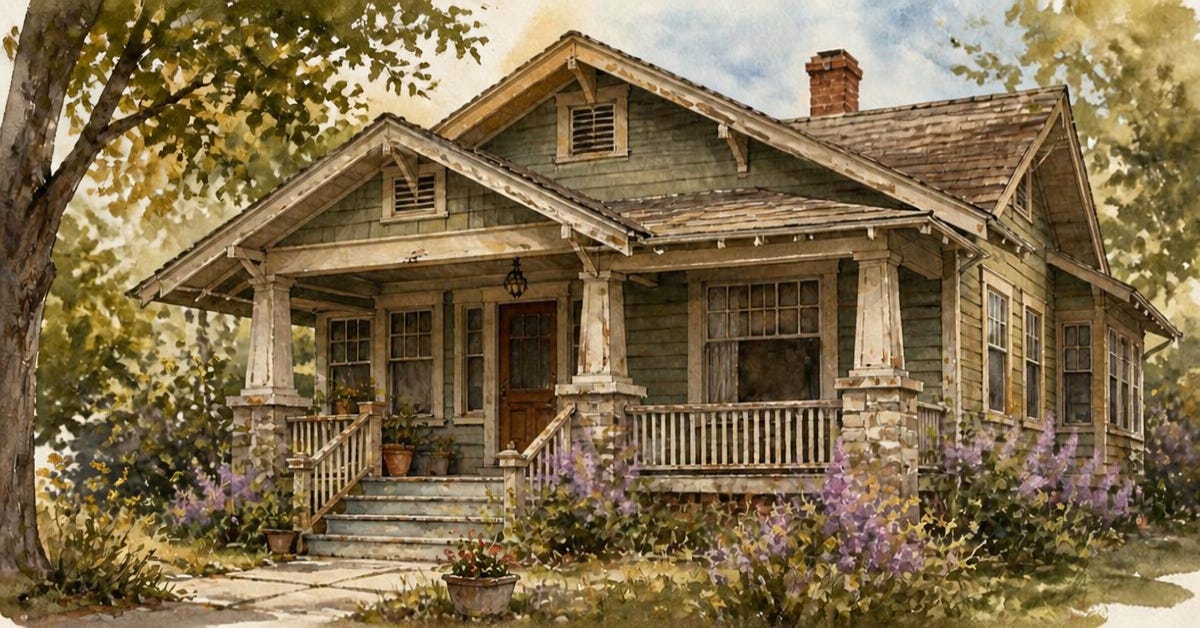
The house on Elm Street had been empty for six years, and in that time Tarot Town had developed a deep and affectionate relationship with it, the way you can love a thing best when you don't have to maintain it. Everyone had a story about the Three of Cups' grandmother's kitchen. After she passed during the COVID lockdowns, the house remained unoccupied. People just couldn't bring themselves to do anything. It stood as a symbol of both happy homespun memories AND a time in collective history that no one wanted to revisit. As a result, nobody had paid the property taxes or done the necessary maintenance. By autumn of this year, the county had run out of patience and grace periods, and the choice was plain: someone buys the house, signs a loan the size of a small mountain, and fixes it, or Death buys it at auction and turns it into something else.
Nobody in Tarot Town likes it when Death shows up with a clipboard, though everybody hires him eventually. He buys what's finished and turns it into what's next: the old mill became apartments, the bowling alley became the library annex, and nobody has ever once thanked him at the time. He would tell you, if you asked, that the house was going to change either way. The only question was who got to decide into what.
The town council meeting on Tuesday night was about as civil as a dogfight in a phone booth. Justice, who has taught most of the town to read and behave, sat at the Emperor's right hand with her glasses on a chain, and she did not need a gavel. The Three of Cups, who had barely slept, stood up to say the house still felt important to her and the rest of the Cups family. Death, in the back row, said that family was lovely, but the roof was collapsing. Somebody's cousin said everybody wanted the lilacs saved, but nobody wanted to be the one holding the shovel.
And the Six of Wands, wearing red leather to match her mood, rose from the third row and said what everyone had been politely not saying: that Tarot Town loved that house the way it loved a funeral, loudly and for one afternoon.
The room went quiet.
From the side wall, the Two of Wands announced that if somebody handed him a key he'd start pulling up the rotten porch at dawn, and he did not appear to have thought about who owned the porch or why that might matter.
The Sheriff, who was leaning in the doorway with his hat in his hand, smiled at the Six of Wands and said mildly, as he glanced toward the Two of Wands, that nobody was pulling up anything until somebody had a key, and the Two of Wands stopped short and nodded as if he'd agreed with him.
The Emperor, who runs the town and dislikes watching a room get away from him, made a snap call on instinct: sixty days, and the Three of Cups gets first claim. Justice peered at him over her glasses and informed him, in the voice she once used on third-graders, that he could not do that.
Then, after a pause, she found a way that he could.
By morning, someone's hasty text had gone to the wrong group chat, and the Sheriff had read three very rude messages about Death's methods.
What followed was sixty days of the least glamorous work in the world.
The Three of Cups sat in the bank and at the county office, learning the system the hard way. There was a long-term plan to write, and then a longer one under it. She learned what the taxes actually were, rather than what everybody remembered them being. She learned what a roof cost, what insurance wanted, what the bank meant by reserves, and exactly how much sentiment a loan officer was prepared to accept as collateral.
The Two of Wands, who had heard "nobody's pulling up anything" as more of a suggestion, went at the porch on day four without a key, and the porch, which had been held together by the laws of physics and happy thoughts for many years, simply gave up the ghost when he pulled that one magic board holding it all together. It went all at once, with him on it.
The Sheriff, who has spent his career being the person who arrives right after things fall down, pulled up with his lights on and no siren, out of respect for the neighbours. He wrote the Two of Wands a citation for trespassing, hauled him out of the hole by the belt, strung yellow tape around the wreckage, and observed that whatever the Two of Wands had been planning to say about that porch, the porch had said it first.
Death, to everyone's surprise, was not bothered at all.
He turned up with his tape measure and an offer: his demolition crew was not coming; he'd take the contractor's job, and everything the house no longer needed would go to his salvage yard. The rotten beams, the mildewed wallpaper, and the splintered porch boards were hauled away without ceremony and without sentiment, and the house, to its own surprise, felt lighter.
The Magician came to supervise, mostly because the Two of Wands had now hit his thumb with a hammer, burned his hand on a torch, and gone through a porch, and was clearly on his way to a fourth accident. The Magician put a plane in his hands, showed him the grain of a board, and said that most things worth building start with knowing how to use the tools in front of you.
The Six of Wands showed up on day six to "help with the design" and spent forty minutes arguing with the Two of Wands about whether the front door should be red. He is family, and therefore the only person alive allowed to tell her no.
He said red was a lot.
She said that was the point.
They shouted, then shouted louder, then went quiet in the way that is not quiet at all, which is how family does it. That was when the Sheriff came by to check on his yellow tape. The Six of Wands, still flushed from the argument, looked at him, looked at the tape, and announced in the middle of Elm Street that she was crazy about him and he could deal with it.
"I'm standing right here," said the Two of Wands.
The Sheriff took off his hat, thought it over for exactly one second, and dealt with it instantly. It was a kiss that would go down in Tarot Town history for generations to come, and for once the Sheriff arrived before something fell down.
The Three of Cups, meanwhile, spent a lot of time alone in her grandmother's empty kitchen with a venti pumpkin spice and a lot of old feelings, and somewhere in the third week she stopped crying about the house and started planning it.
There were things she wanted to keep because they mattered, and things she discovered she only wanted to keep because they had always been there. Death made her choose.
The lilacs could stay.
The floors could stay.
But certain walls, supporting beams, and the back stairs could not.
For two days she was furious with him, especially about the stairs. On the third, he showed her the rot that was developing and asked whether she wanted the structures within the house or the wood itself.
That was a different question.
It was grit and not luck that got her through the sixty days, and she knew it, and the whole town knew it too. By the final week, she could tell you what the mortgage payment would be, when the county bill came due, what had been spent on lumber, and which repairs could wait until spring. Everybody else remembered her grandmother's house.
She knew what it would take to keep it standing.
On the last day, Justice read the contract aloud, every clause, as is her habit.
The Three of Cups followed along with a folder open in front of her. When Justice reached the tax schedule, she already had the page marked. When she reached the financing terms, the Three of Cups quietly corrected a figure that had been carried over from an earlier draft.
Justice stopped and looked over her glasses, checked twice, and then nodded once and continued reading.
The Three of Cups would own the house. Death would renovate it. The lilacs would stay, and the kitchen would stay, and the salvaged wood from the old back stairs and support beams inside the house would come back as the legs and top of a very long table, contracted by Death to the Seven and Eight of Coins.
The Three of Cups signed, then Death, then Justice stamped it with a flourish that made the whole room straighten up.
The Four of Coins, acting as the representative of the bank handed the Three of Cups the keys.
Then he handed her the mortgage schedule.
The county clerk handed her the property-tax dates.
Death, apparently unwilling to let a moment become too ceremonial, reminded her that the gutters would need looking at again in five years.
The Three of Cups put all three things into her folder.
"Fine," she said.
And meant it.
Before the ink dried, the Six of Wands announced that she and the Sheriff would be having dinner on Friday, which surprised absolutely nobody except possibly the Sheriff, who put his hat back on and said that sounded fine.
The Star brought paintings for the front hall, and the open house that came a few months later felt like a gallery opening and a family reunion rolled into one, with the long table set in the brand new dining room beside the kitchen she'd been able to keep…with a few modifications from Death’s crew that brought it up to code. The front door, for the record, was still red.
The only real crisis came at dinner, when the guests stood in a clump over the seating chart, each one waiting for someone else to choose, desperate to please everyone and therefore unable to please anyone.
The Three of Cups finally laughed and told them to sit anywhere.
They did.
Death took the chair at the end, looked around at the house he had changed, and for once, everyone thanked him. "Don't get used to that," the Sheriff said, as he and Death laughed a little.